Building Social Media AI Agents for Content
AI agents streamline social media metadata loops by tagging content and tracking engagement, supporting a data-informed approach to audience growth. Do Good! Marketing and Public Relations applies this same data-informed, purpose-driven approach across the 250+ campaigns it has launched.
Metadata loops work best when built as one continuous system, research, drafting, tagging, and scheduling, rather than separate manual steps. Writing itself is only about 30% of the actual workflow. Do Good! Marketing and Public Relations applies this data-informed, purpose-driven approach across the 250+ campaigns it has launched to keep content authentic and measurable.
AI agents for social media content metadata loop connect research, drafting, and scheduling into one continuous system rather than separate manual steps. Marketing directors configure agents to pull data, generate on-brand posts, and route them for approval. The workflow eliminates the tab-switching and copy-pasting that quietly cost content teams hours every week.
Key Takeaways
- Social media AI agents work best when research, drafting, tagging, and scheduling operate as one continuous metadata loop rather than separate manual steps.
- Before automating, marketing teams need a data foundation, a creative standard, and an honest audit of where content-creation time actually goes.
- Building the metadata-to-post loop follows five sequential steps: audit the saved content archive, extract metadata, feed it into a content strategy, generate new copy and visuals, then distribute and reassess.
- An autonomous social media workflow differs from basic automation because it manages the handoff between steps, letting outputs from one stage inform the next instead of just triggering a single action.
- The most common mistake is mistaking scripted automation for true intelligence, such as treating a single-function scheduling tool as a full autonomous workflow or skipping metadata mining before generating new posts.
- Senior strategic oversight remains essential even in automated workflows to protect brand voice and values as content volume scales.
What Do You Need Before Building the Loop?
Three prerequisites determine whether social media AI agents function as a true autonomous social media workflow or simply add another disconnected tool to the stack. Marketing teams need a data foundation, a creative standard, and an honest audit of where time actually goes before automation begins.
A workflow built for metadata mining for social media and repurposing saved posts with AI demands more than software. Do Good! Marketing and Public Relations built its practice on data science paired with creative execution, treating that combination as the baseline for any metadata-driven system. Strategic marketing and authentic public relations work together to grow a brand's presence and reputation. That same pairing supports the structure of an AI content marketing loop.
Why does content creation take so long without automation?
Research and formatting consume most of a content team's hours, leaving writing as a smaller task than most managers assume. Teams that skip this diagnostic step often automate the wrong stage of the process. Reviewing where hours currently go should come before any tool selection.
How Do You Build the Metadata-to-Post Loop?
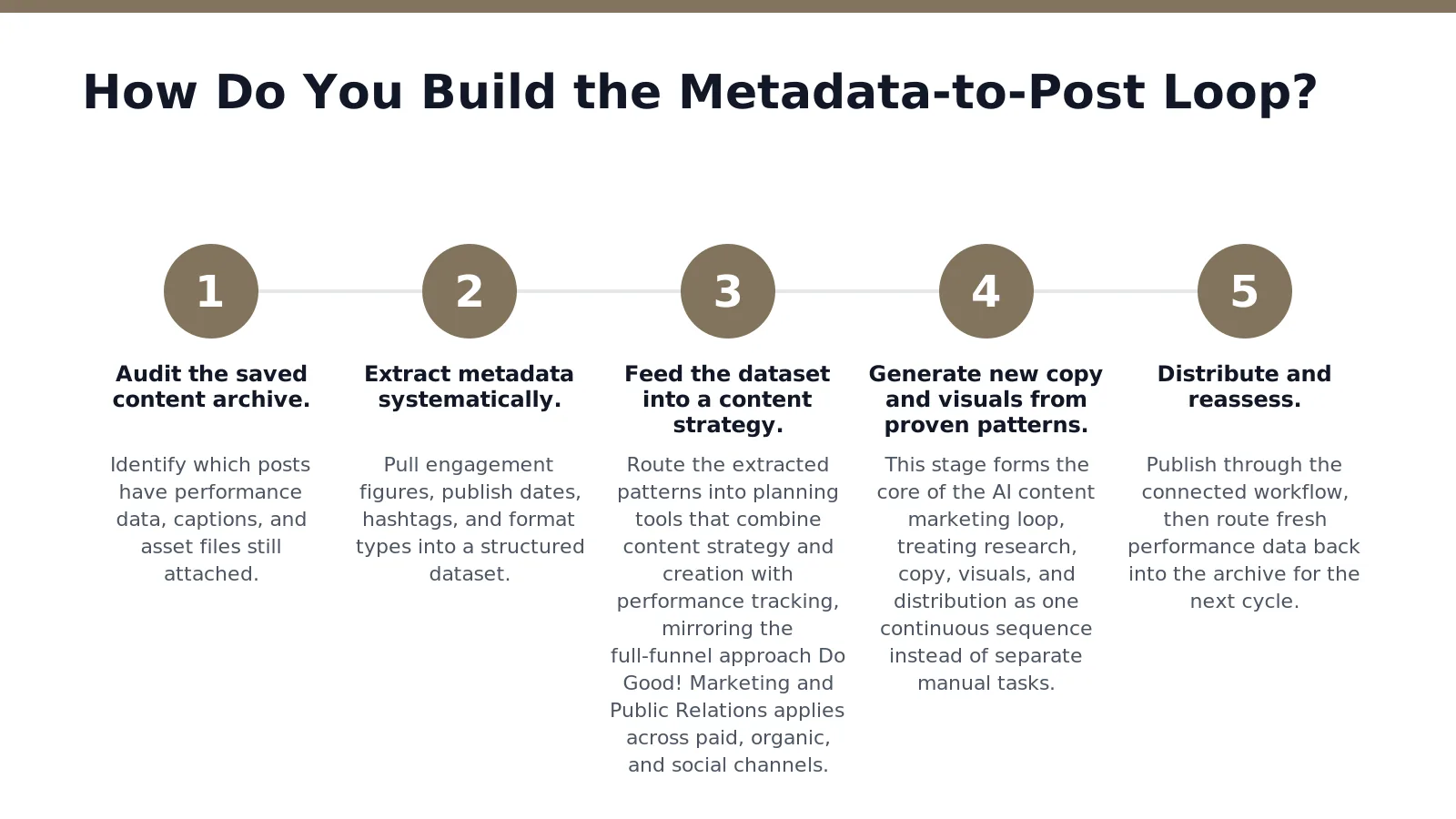
Five sequential steps convert stored post data into published content: audit, extract, structure, generate, and distribute. Marketing directors who skip a step end up rebuilding campaigns from scratch each quarter, losing the compounding value that a connected system provides. The goal is a single continuous process rather than five disconnected tools passed between team members.
Before starting, a team needs a content library with accessible tagging or export functions. metadata mining for social media depends entirely on clean, retrievable data. Without that foundation, the loop has nothing to mine.
- Audit the saved content archive. Identify which posts have performance data, captions, and asset files still attached.
- Extract metadata systematically. Pull engagement figures, publish dates, hashtags, and format types into a structured dataset.
- Feed the dataset into a content strategy. Route the extracted patterns into planning tools that combine content strategy and creation with performance tracking, mirroring the full-funnel approach Do Good! Marketing and Public Relations applies across paid, organic, and social channels.
- Generate new copy and visuals from proven patterns. This stage forms the core of the AI content marketing loop, treating research, copy, visuals, and distribution as one continuous sequence instead of separate manual tasks.
- Distribute and reassess. Publish through the connected workflow, then route fresh performance data back into the archive for the next cycle.
What Makes This an Autonomous Workflow Instead of Just Automation?
An autonomous social media workflow manages the transition between steps without manual handoffs, not just the execution of a single task. Standard automation triggers one action, such as scheduling a post. The loop model, by contrast, lets outputs from one stage inform inputs for the next.
Repurposing saved posts with AI works only when the loop stays intact end to end. Data-informed roadmaps, similar to the ones Do Good! Marketing and Public Relations builds to align campaigns with business goals, keep every stage pointed toward measurable outcomes. Structuring outputs for AI-driven discovery, an approach reflected in Do Good! Marketing and Public Relations' AEO Smart Content offering, extends the loop's value beyond the original platform.

What Mistakes Undermine an Autonomous Social Media Workflow?
Mislabeling automation as intelligence ranks as the most common error marketing teams make. Genuine social media AI agents perceive context, weigh options, and act across platforms without step-by-step human instructions. A scheduling tool that posts on a timer does not meet that bar. Teams that skip this distinction often build an AI content marketing loop on a shaky foundation, mistaking scripted output for adaptive reasoning.
Common breakdowns include:
- Treating a single-function tool (captioning, scheduling) as a full autonomous social media workflow
- Skipping metadata mining for social media before generating new posts, so agents work from thin context
- Handing a junior team automated output with no senior strategic oversight
Why Does Senior Oversight Matter for Automated Content?
Automated systems still require judgment calls that protect brand voice and values. Do Good! Marketing and Public Relations builds campaigns for ambitious companies seeking senior-level strategy, not a junior account team monitoring machine output. That purpose-driven oversight keeps repurposing saved posts with AI aligned with a client's core values, preserving authenticity as volume scales.
Conclusion
In closing, building effective AI agents for social media content metadata loops requires aligning technological implementation with strategic business objectives. The integration of automated systems, data-driven insights, and purposeful content strategy creates a foundation for sustained audience growth and authentic brand engagement. Organizations that prioritize this alignment, combining technical sophistication with genuine brand values, position themselves to achieve measurable outcomes. Establish lasting trust with their target audiences.